Multi-Agent Blog Writer
A sophisticated multi-agent system using LangChain and LangGraph to automate blog post generation, from planning and research to drafting.
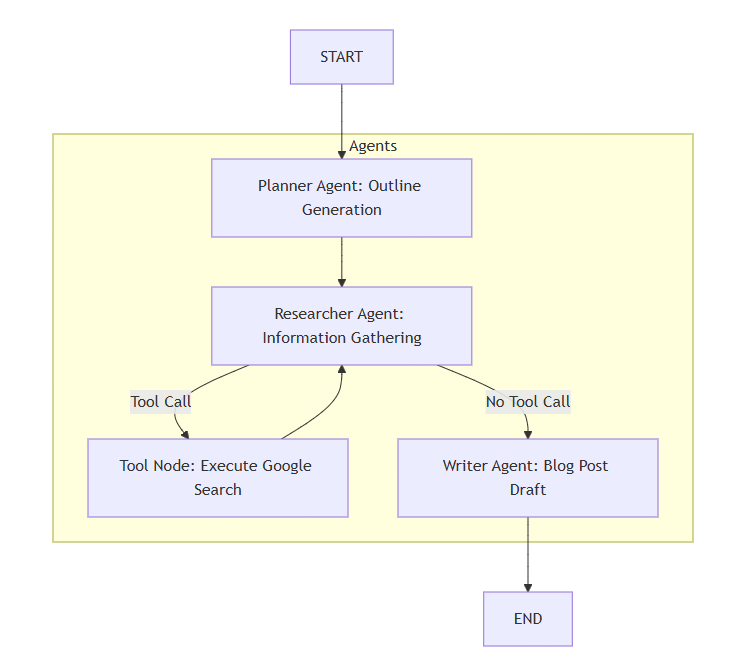
Overview
The Multi-Agent Blog Writer is an AI system built with LangChain and LangGraph that takes a single topic and autonomously produces a finished blog draft—handling planning, research, and writing without manual intervention. A LangGraph workflow orchestrates three specialized agents: a Planner that turns the topic into a detailed outline and research tasks, a Researcher that decides when to invoke a Google Search tool to gather information, and a Writer that synthesizes the plan and findings into a complete draft. A dedicated Tool Node executes searches and feeds results back to the Researcher in a loop. As the AI/ML engineer, Rohan designed the LangGraph state machine, built and integrated each agent, configured the Google Custom Search API, and set up the local deployment.
The problem
Automating the content creation process for blog posts, reducing manual effort in planning, researching, and drafting.
Key features
- Automated Content Planning (Planner Agent)
- Intelligent Research (Researcher Agent with Google Search integration)
- Blog Post Drafting (Writer Agent)
- Orchestrated Workflow via LangGraph
What I did
- Designed and implemented the LangGraph workflow, developed and integrated each specialized AI agent (Planner, Researcher, Writer), configured Google Search API for research, and set up environment for local deployment
AI under the hood
At its core is a stateful agent graph built with LangChain and LangGraph. Rather than a single prompt, the system models content creation as a directed workflow where control passes between three role-specialized LLM agents—Planner, Researcher, and Writer. The Researcher agent demonstrates tool-augmented reasoning: it conditionally routes to a Tool Node that runs Google Custom Search queries, then loops the results back for further reasoning before handing off to the Writer. This LangGraph orchestration—with explicit nodes, edges, and conditional transitions—shows how multi-agent coordination produces higher-quality output than one-shot generation.