ProfitPilot AI Business Optimization Assistant
An intelligent, multi-agent assistant empowering small and medium-sized businesses with data-driven insights and actionable recommendations using cutting-edge AI and cloud data solutions.
Overview
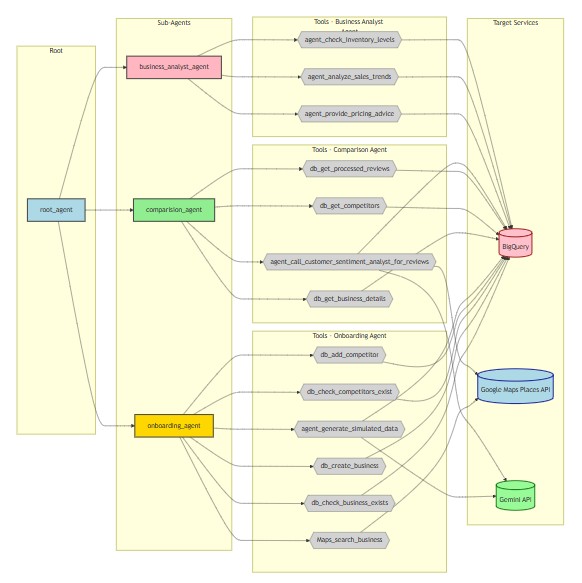
ProfitPilot AI is an intelligent, multi-agent assistant that gives small and medium-sized businesses the kind of data-driven guidance usually reserved for larger firms. A Root Agent interprets user queries and delegates to specialized sub-agents: an Onboarding Agent that sets up the business and discovers competitors via Google Maps, a Comparison Agent that mines public reviews for competitive intelligence, and a Business Analyst Agent that surfaces sales trends, inventory levels, and strategic pricing advice. Built on Google Cloud with Gemini 1.5 Flash, BigQuery for data warehousing, and the Google Maps Places API, it even seeds simulated data so new businesses can start immediately. As AI architect and developer, Rohan designed the agent architecture, integrated each Google service, and built the core logic for every specialized agent.
The problem
Small and medium-sized businesses often lack the resources and expertise to leverage data for optimizing profitability, managing inventory, and understanding market dynamics.
Key features
- Intelligent Onboarding & Data Seeding
- Dynamic Business Analytics (Sales Trends, Inventory, Pricing Advice)
- Competitive Intelligence (Google Maps & Gemini)
- Centralized Orchestration via Root Agent
What I did
- Designed and implemented the multi-agent architecture, integrated Google Gemini 1.5 Flash API
- Google BigQuery, and Google Maps Places API, developed the core logic for each specialized AI agent, and managed deployment
AI under the hood
ProfitPilot is built on an agentic architecture orchestrated by Google's Agent Development Kit. A Gemini 1.5 Flash–powered Root Agent interprets intent and routes work to three specialized sub-agents—Onboarding, Comparison, and Business Analyst—each equipped with its own tools. Gemini drives every reasoning task: generating simulated sales and inventory data, analyzing customer-review sentiment, spotting sales trends, and producing pricing advice. Those agents ground their reasoning in real data through tool calls to Google BigQuery (the data warehouse) and the Google Maps Places API (competitor discovery and reviews)—a clear example of LLMs combined with structured data and external APIs for actionable insight.